paying cash for a car
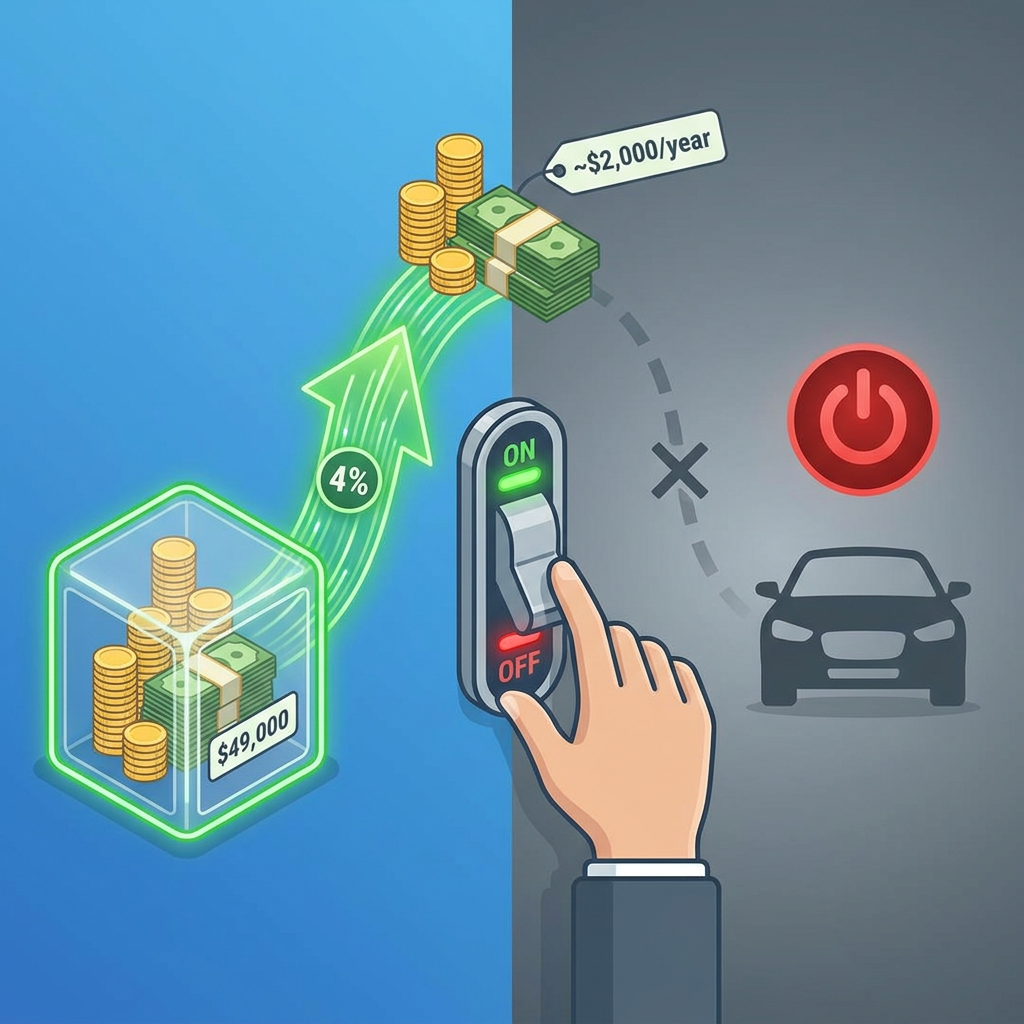
Paying cash for a car turns off the income that money was paying you.
The average new car now runs about $49,000.
Sitting in a high-yield savings account, a short Treasury, or a CD, that money earns around 4% right now.
On $49,000, that's close to $2,000 a year in income.
Pay cash, and you give up that $2,000 a year, every year you own the car.
It doesn't come back when you sell, because by then the car is worth a fraction of what you paid.
So the real question comes down to the spread.
The loan rate on one side, and what your cash safely earns on the other.
If a dealer offers 0% or 2.9% while your cash earns 4%, let them lend to you for almost nothing and keep your cash working.
If the only loan is 7% and your cash earns 4%, the loan costs more than your money makes, so paying cash wins.
One catch bites hardest in retirement.
If the market is down the year you buy and you sell investments to free up the cash, you lock in a loss and pull money out at the worst possible time.
I recently sold one of my own rentals because about $100,000 in equity was throwing off only $300 or $400 a month, so I've learned to ask what a dollar is actually earning before I leave it sitting.
Being debt-free feels good, and that feeling is worth something.
Just know the price of it is the income that money would have kept paying you.
As promised, income over wealth in under a minute.
- Dan
The average new car now runs about $49,000.
Sitting in a high-yield savings account, a short Treasury, or a CD, that money earns around 4% right now.
On $49,000, that's close to $2,000 a year in income.
Pay cash, and you give up that $2,000 a year, every year you own the car.
It doesn't come back when you sell, because by then the car is worth a fraction of what you paid.
So the real question comes down to the spread.
The loan rate on one side, and what your cash safely earns on the other.
If a dealer offers 0% or 2.9% while your cash earns 4%, let them lend to you for almost nothing and keep your cash working.
If the only loan is 7% and your cash earns 4%, the loan costs more than your money makes, so paying cash wins.
One catch bites hardest in retirement.
If the market is down the year you buy and you sell investments to free up the cash, you lock in a loss and pull money out at the worst possible time.
I recently sold one of my own rentals because about $100,000 in equity was throwing off only $300 or $400 a month, so I've learned to ask what a dollar is actually earning before I leave it sitting.
Being debt-free feels good, and that feeling is worth something.
Just know the price of it is the income that money would have kept paying you.
As promised, income over wealth in under a minute.
- Dan