How to Become a Private Lender
A private lender is a person who does what a bank does on one house: lends the purchase money, holds a recorded lien, and collects a monthly payment until the loan is paid off. Here are the seven steps from a savings or retirement account to a note that pays you, in the order they happen.
 Dan WilsonReal estate investor and private lender
- 01Decide which money lendsCash, or a self-directed IRA.
- 02Learn what a note isThe promissory note and the recorded lien.
- 03Write your rules firstPosition, cushion, term, states.
- 04Meet operators the honest wayRooms where deals get closed, never a cold pitch.
- 05Vet the dealThe ten questions, in order.
- 06Close through a title companyFour documents, then the wire.
- 07Collect and keep recordsPayments, taxes, insurance, the payoff.
Decide which money lends
The account you lend from decides the paperwork and the taxes.
Two kinds of money make private loans. Cash in a taxable account is the simple version: you wire it at closing, the payments come to your bank, and the interest is ordinary income on your return each year. A retirement account can lend too, and that is how a lot of private lending gets done, because it is where the money sits. A regular brokerage IRA holds stocks and funds and nothing else. A self-directed IRA at a specialized custodian can hold a private note, and the payments go back into the account tax-deferred, or tax-free in a Roth. Eight custodians that hold notes, with their fees, are compared here.
Either way, the money has to be money you will not need back before the note ends. A private note has no exit button. That single fact decides who should lend and who should pass.
Learn what a note is
Two documents, one payment a month.
A private mortgage note is two documents. The promissory note is the borrower's written promise to pay: the amount, the rate, the term, the payment. The mortgage (a deed of trust in some states) is recorded at the county and gives you a claim on the house if the promise is broken. A fully amortized note pays the same amount every month, part interest and part principal, until the balance is zero. An interest-only note pays interest each month and the whole principal on the last day.
Private lenders on residential real estate commonly charge 8 to 14%, depending on lien position, loan-to-value, and term (The Entrust Group, NoteInvestor.com). That is the market range, and no one's particular deal. Like every investment, a private note carries risk: the money is committed for the term, and if a borrower stops paying, the recorded lien is what gets it back, after a wait the state sets. Put any loan, rate and term into the calculator to see what the lender gets each month and how the balance falls.
Write your rules before you meet a deal
A deal in front of you is a bad time to decide what you would accept.
Decide four things on paper first. Position: first lien only, or will you take second position behind a bank, knowing a senior foreclosure can wipe a junior claim off the property? Cushion: the most you will lend against a stressed value of the house, with selling costs taken out. Term: how long the money can be gone, and whether you will accept a balloon payment at the end. States: where you will lend, because the wait after a default is set by the state the house sits in, and it runs from about five months to more than nine years. The state-by-state timelines are here.
Write the four answers down. Every deal that comes later gets measured against them, and the ones that fail get a no before anyone gets attached.
Meet operators the honest way
Good borrowers are found in the rooms where deals close.
The operators worth lending to are local real estate investors who buy, fix, rent or sell houses and fund them with private money instead of bank loans. You meet them at the local real estate investors' association, through the title companies and closing attorneys who see who actually closes, and through other lenders. Ask a title company who they close private loans for. Ask an operator for the names of their past lenders and the title company they use, then call both.
The rule that protects you here is the law. A deal that is legitimately raising private money either cannot be advertised to strangers at all, or has to verify an investor's finances before accepting a dollar. So a pitch that finds you cold, a social media message promising a return, a stranger with a deal that "closes Friday," fails at the door. A legitimate operator expects to answer your questions first and has a process for getting to know you before money is discussed. When in doubt, check the person and the deal with your state securities regulator.
Vet the deal
Ten questions, three layers. Any layer fails, no deal.
Vet the operator first: a track record you can verify through title companies and past lenders, a background and litigation check, and a reason they stay committed if the deal gets hard. Then the deal: what the house is worth from evidence you trust, what position you are in and what sits ahead of you, how the loan actually gets paid back, what your cushion is and which way it moves. Then the paperwork and terms. The ten-question due-diligence checklist walks through all of it in order, and it is the same list I would want any borrower to answer, including me.
Close through a title company
Four documents, then the wire. The documents are the deal.
A private loan closes the way a bank loan closes: through a licensed title company or closing attorney, with a title search that shows what liens already sit on the house. Four documents make the loan real. The promissory note, signed by the borrower. The mortgage or deed of trust, recorded at the county so the world can see your claim. Hazard insurance on the house naming you as the mortgagee, so a fire pays you before it pays anyone else. A lender's title policy, which insures your lien position against title problems nobody found. The title company records the mortgage and disburses your wire at the same closing, so the money never moves before the lien exists.
If you lend from a self-directed IRA, the custodian sends the wire and the note is titled in the custodian's name for the benefit of your IRA. The paperwork takes a few extra days. Plan for that before the closing date is set.
Collect, verify, and plan the end
The loan is a five-year relationship, and it has an end date.
Payments arrive monthly, by ACH or through a loan servicer that tracks the balance and sends the year-end statement. A servicer is optional; verification is not. Once a year, ask for proof that the property taxes and the hazard insurance are paid, because an unpaid tax bill sits ahead of your lien. In a taxable account, the interest is ordinary income. In an IRA, it goes back into the account and the custodian files the annual valuation.
Most missed payments are late, not lost, and the cure period written into the note exists for that. If a borrower stops paying for good, the recorded lien is what gets the money back, through the process your state uses. At the other end, when the last payment clears or the house sells, a release of mortgage gets recorded, and the note is done. Then you decide whether to do it again.
Who this is for, and who should pass. Private lending fits someone with money that can stay committed for the full term, who wants a fixed monthly payment backed by a house rather than a daily price, and who is willing to read four documents and make a few phone calls before wiring a dollar. It is not for money you might need back soon, for anyone who wants to be able to sell on a bad day, or for anyone who would rather trust a pitch than check it.
The Private Lender Starter Kit
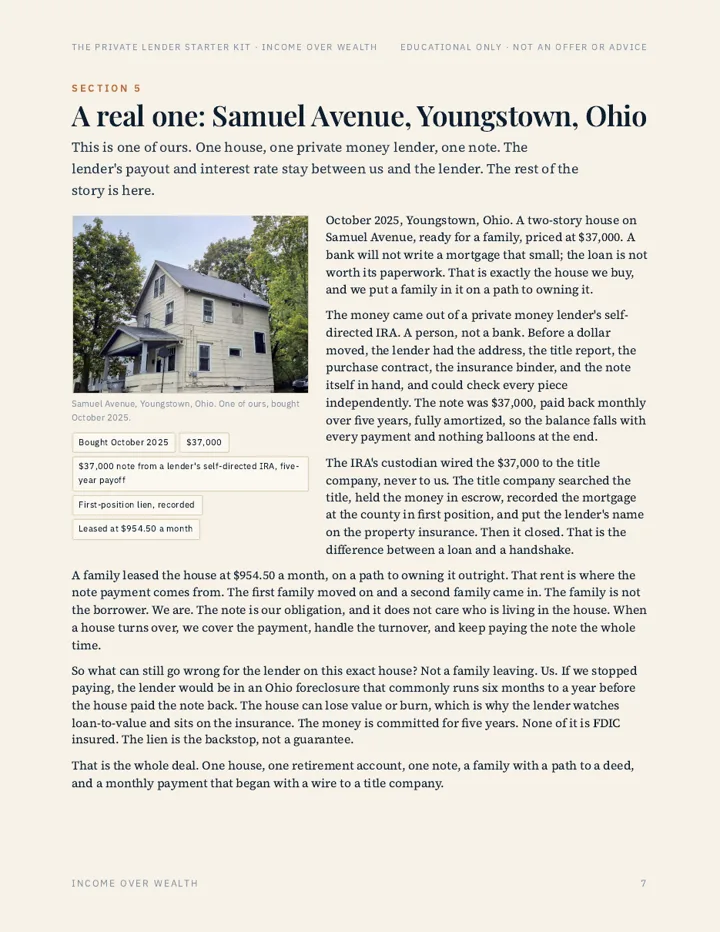
Free, 23 pages: what a $50,000 note pays month by month, a real $37,000 house in Youngstown, Ohio, the IRA path with eight custodians compared, the four documents, and the ten questions to ask any borrower before a dollar moves.
Send Me the Starter Kit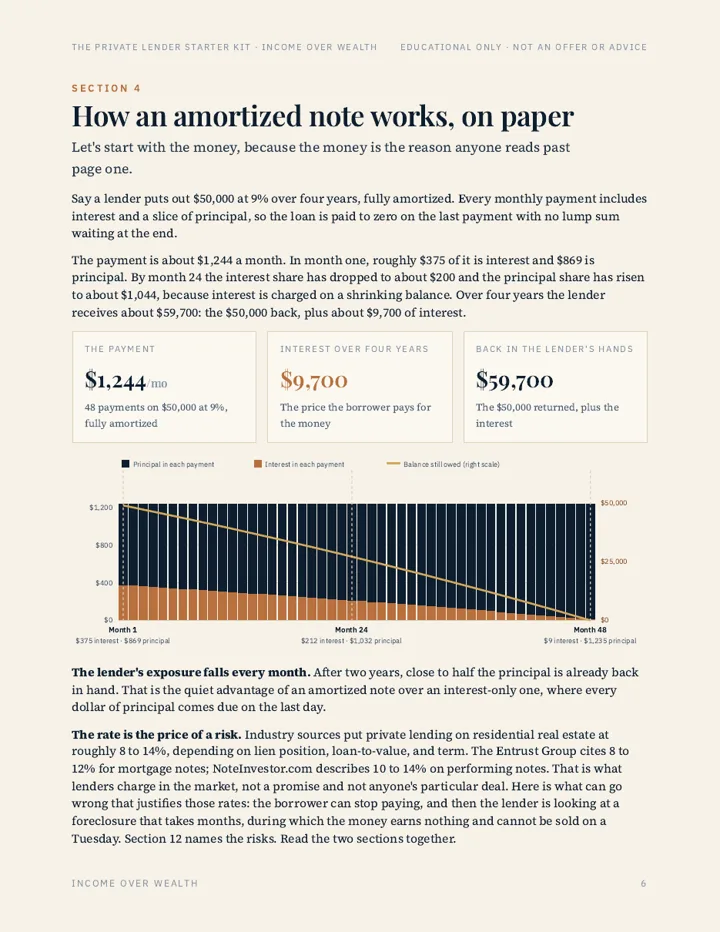
Educational content only. Nothing here is an offer to sell or a solicitation of an offer to buy any security, loan, or investment, and nothing here is legal, tax, or investment advice. Any examples are hypothetical and for illustration only. Consult your own advisors before making any financial decision.