Self-Directed IRA Custodians That Hold Private Notes
Eight custodians that list private mortgage notes as a permitted asset, with the pricing model and the fees I could read on each custodian's own fee page in September 2026. Where a schedule sits behind a form, the model is described and the figure is left for you to check.
 Dan WilsonReal estate investor and private lender
- 8 custodiansEvery one lists promissory notes and mortgage notes as an asset it will hold.
- $1,280 to $2,935What five years of holding one $50,000 note costs at the seven custodians whose schedules allow the arithmetic.
- One questionWhat does it cost to hold one note for its full term, wire at closing and every monthly payment included?
Pricing model, published fees, and what five years costs
Every fee below was read on the custodian's own fee page or fee-schedule PDF on September 14, 2026. The five-year figure assumes one account holding one $50,000 note and nothing else: setup, five annual fees, one outgoing wire at closing, and 60 monthly payments coming in. Client counts and assets under custody are each custodian's own published figures where it publishes them. Fees change, some every year. Check the custodian's own page before you open an account.
$350 a year while the account holds under $50,000, $500 from $50,000 to $99,999. Setup $50 online. Check and ACH deposits included, wire $30.
Depends on whether the first year bills in the $50,000 tier.
$139 a quarter, first asset included. $75 to place the investment, wire $30, setup $50.
A $75 asset retirement fee may apply at payoff.
No transaction, check, or asset fees. Wire $25. The schedule PDF lists no setup fee and the company's own comparison table shows $0.
Single asset, up to $50,000 of value; 0.17% of value above that, capped at $2,299. Note purchase $105 to $175, wire $30, setup $50.
The fee page prices a note purchase at both $105 and $175.
$37.50 a quarter under $30,000 invested, $100 above. Private investment $75, wire $25, no setup fee.
Falls once more than $20,000 of principal has come back.
Includes up to three assets. Setup $50, asset processing $50, wire $35, no fee on incoming payments.
Payoff is priced as asset processing, likely another $50.
Setup $50. Twelve incoming payments a year are free, $10 each after that. Wire $15.
A monthly note uses exactly the free allowance.
Silver $30 a month with a $360 setup, Gold $40 a month with a $600 setup. Wire $35. The custodian, Digital Trust, charges asset fees on a schedule it does not publish.
Rocket Dollar's own fees alone come to $2,195 on Silver.
Five years of one $50,000 note, custodian by custodian
Setup, five annual fees, one wire out, sixty payments in. Where a schedule gives a range, the bar shows the low end. Nobody publishes this comparison; every figure traces to the custodian's own schedule as read on September 14, 2026.
Entrust is $1,280 to $1,350 depending on which note-purchase fee applies. Equity Trust is $1,830 to $1,980 depending on the first year's tier. Alto is at most $2,100 and falls as principal comes back. Rocket Dollar's $2,195 covers its own Silver subscription and setup only; its custodian's asset and incoming-payment fees are not published, so the true figure is higher by an unknown amount. Madison Trust may add $75 at payoff and Directed IRA $50.
Why a self-directed IRA charges fees at all
A brokerage IRA looks free because the funds inside it pay the custodian out of their expense ratios. A self-directed custodian holds an asset it did not sell you, so it charges you directly for the work the IRS requires of it: recordkeeping, the annual fair-market valuation, the 5498 and 1099-R filings, and processing every wire out and every payment in.
Ask one question before you open an account: what does it cost to hold one promissory note for its full term, including the wire at closing and each monthly payment coming in? A per-transaction schedule can cost more on a monthly note than a higher flat fee.
The rule that matters most. An IRA cannot do business with you or your family. The IRS calls these prohibited transactions, and the disqualified persons include you, your spouse, your parents, your children and their spouses, and any business you control. Your IRA can't lend to any of them, and it can't lend on a house any of you use. The penalty is severe: the whole account is treated as distributed as of the first day of that year. Lending to an unrelated operator on a house you'll never live in is the clean version. Keep it clean.
Three steps from a rollover IRA to a funded note
Open a self-directed IRA
A regular brokerage IRA holds stocks and funds and nothing else. A self-directed IRA at a specialized custodian can hold a private note, because the custodian's job is to hold and report on assets it didn't sell you.
Roll the money over
A direct rollover from the old plan to the new custodian. The money never touches your hands, so there is no tax and no penalty. Two to four weeks of paperwork is typical.
Direct the loan
You find and vet the borrower. The custodian wires the money at closing and holds the note, titled "Custodian FBO Your Name IRA." Every payment goes back into the IRA, tax-deferred in a traditional account and tax-free in a Roth.
The Private Lender Starter Kit
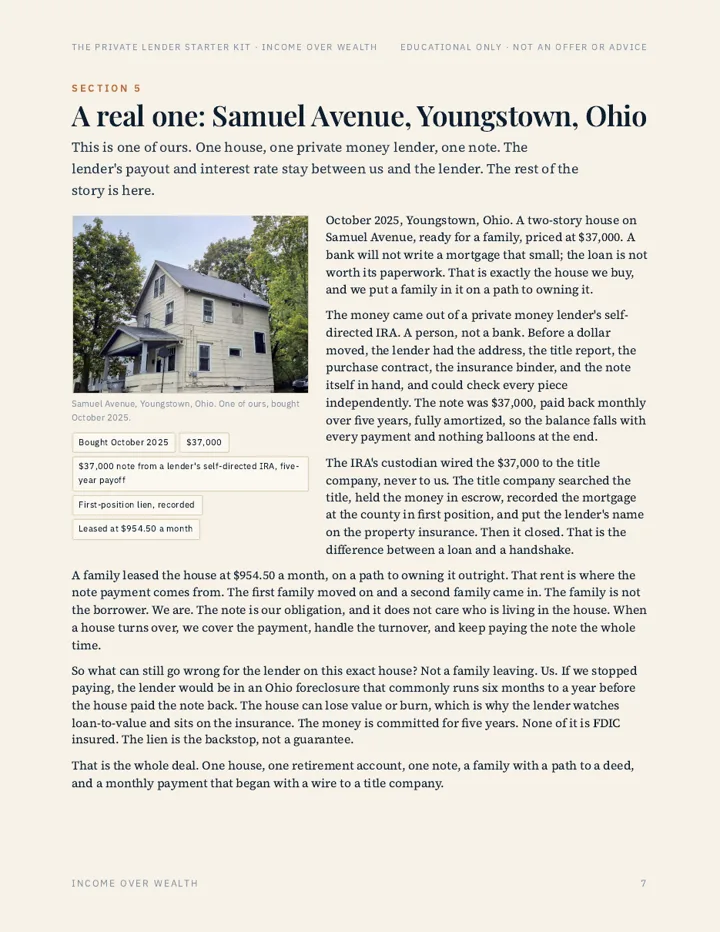
Free, 23 pages: what a $50,000 note pays month by month, a real $37,000 house in Youngstown, Ohio, the IRA path in full, and the ten questions to ask any borrower before a dollar moves.
Send Me the Starter Kit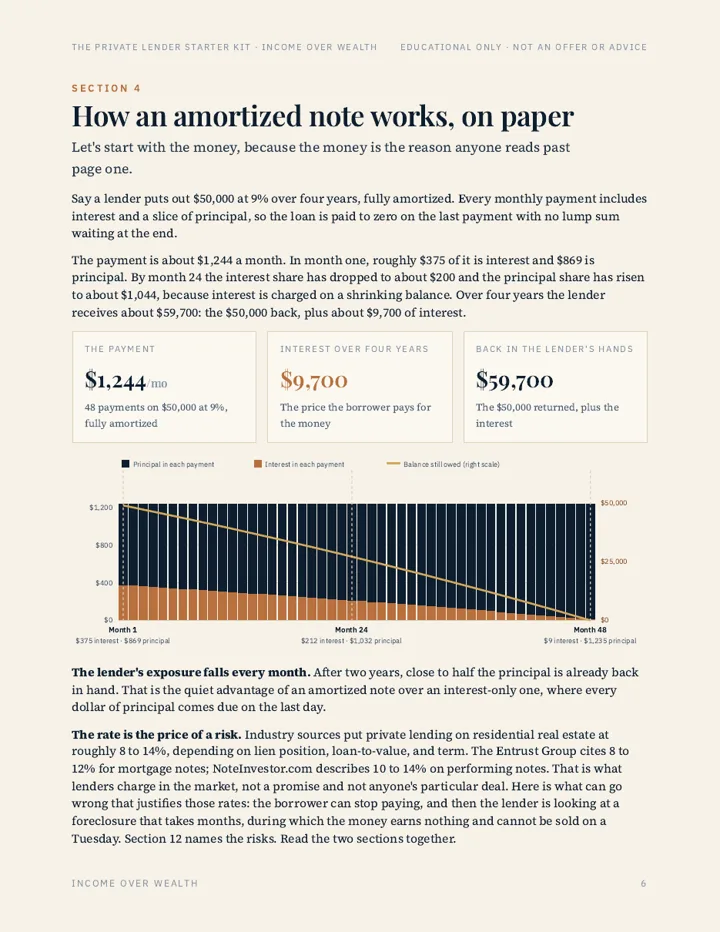

Educational content only. Nothing here is an offer to sell or a solicitation of an offer to buy any security, loan, or investment, and nothing here is legal, tax, or investment advice. Any examples are hypothetical and for illustration only. Consult your own advisors before making any financial decision.