Private Mortgage Note Calculator
What a fully amortized note pays the lender every month, how much of each payment is interest and how much is principal coming back, and how the balance falls to zero. Enter any loan, any rate, any term.
 Dan WilsonReal estate investor and private lender
Where each year's payments go
| Year | Paid to lender | Interest | Principal returned | Balance at year end |
|---|
Why the balance falls faster every year
A fully amortized note pays the lender the same amount every month. Early on, most of each payment is interest; by the end, most of it is principal coming home. That is why the balance line falls faster as the term goes on, and why the lender's exposure shrinks every month without anyone selling anything. An interest-only note pays no principal along the way and leaves every dollar of it due on the last day.
Like every investment, a private note carries risk. The money is committed for the term, and if a borrower stops paying, the recorded lien is what gets it back, after a wait that the state sets. The ten-question checklist is how a lender decides whether a particular note is worth that.
The Private Lender Starter Kit
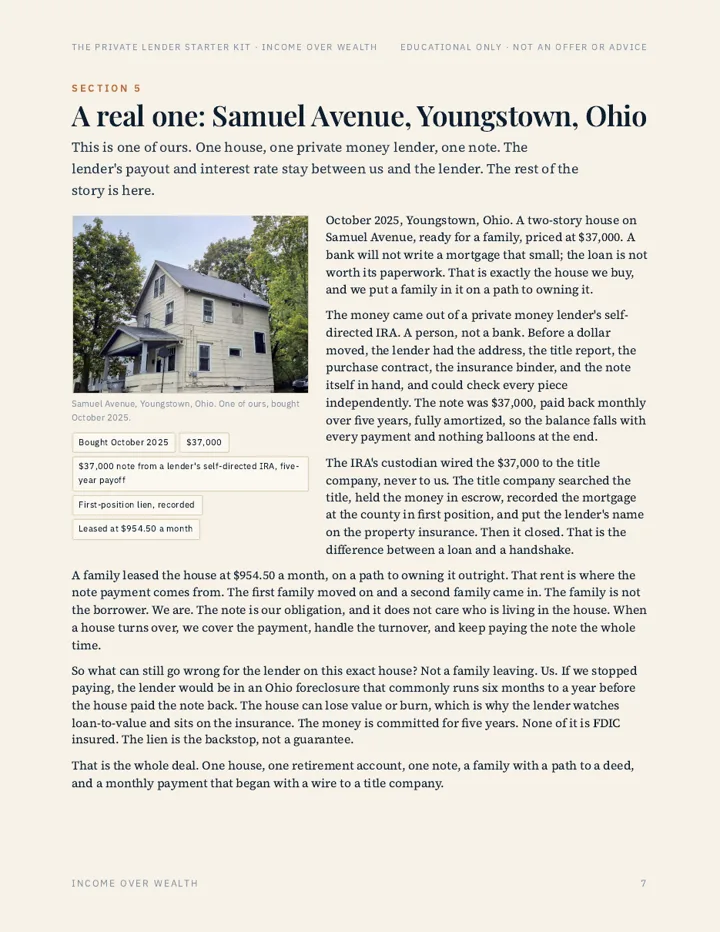
Free, 23 pages: a $50,000 note charted month by month, a real $37,000 house in Youngstown, Ohio, the IRA path with eight custodians compared, and the ten questions to ask any borrower before a dollar moves.
Send Me the Starter Kit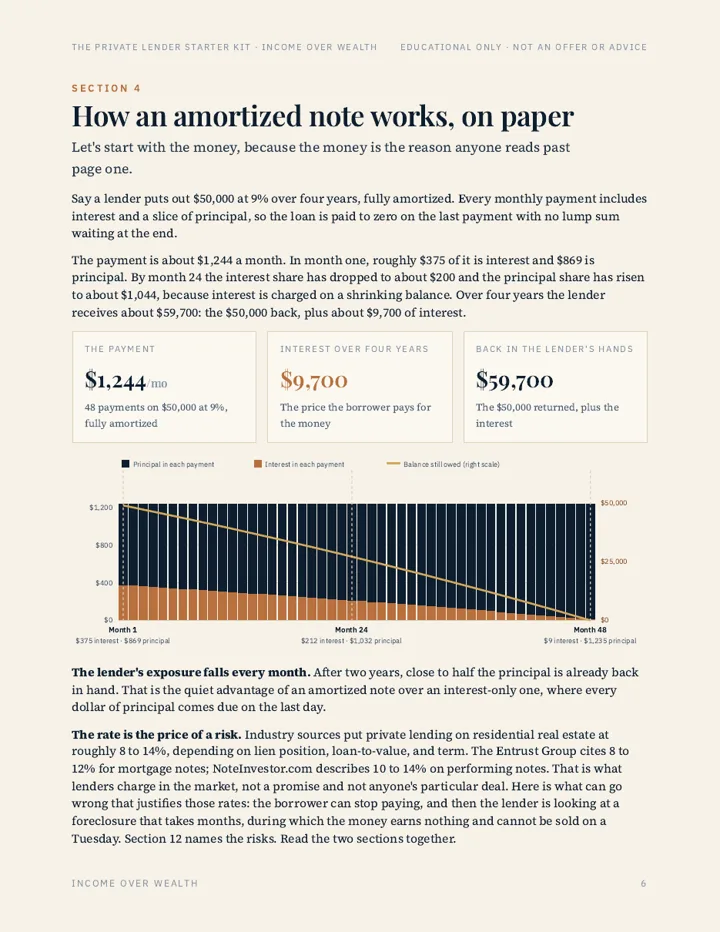

Educational content only. Nothing here is an offer to sell or a solicitation of an offer to buy any security, loan, or investment, and nothing here is legal, tax, or investment advice. Any examples are hypothetical and for illustration only. Consult your own advisors before making any financial decision.